How microbial communities assemble, and whether the state they reach is set by rules or by history.

Sebastian Correa-Gallego
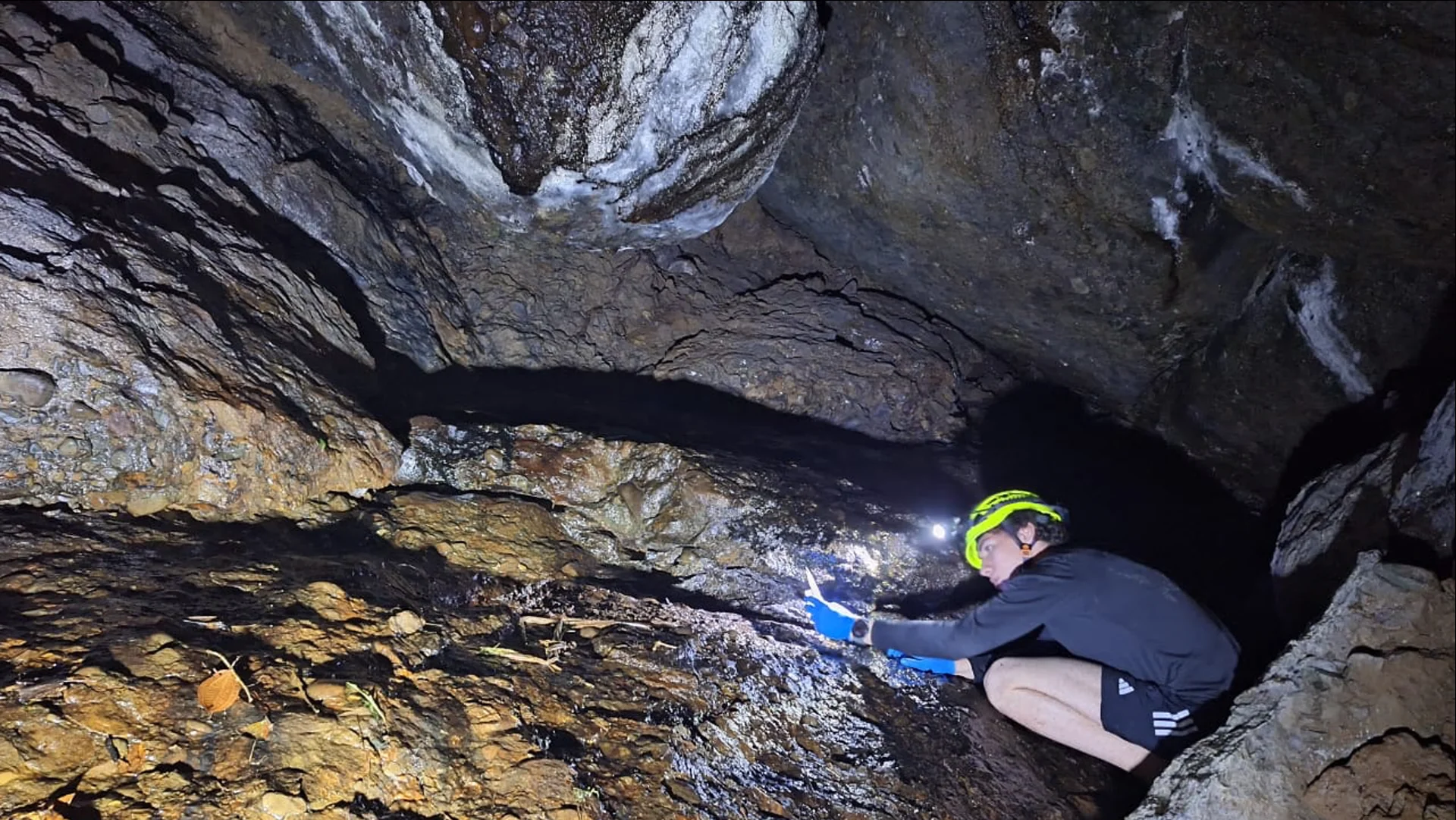
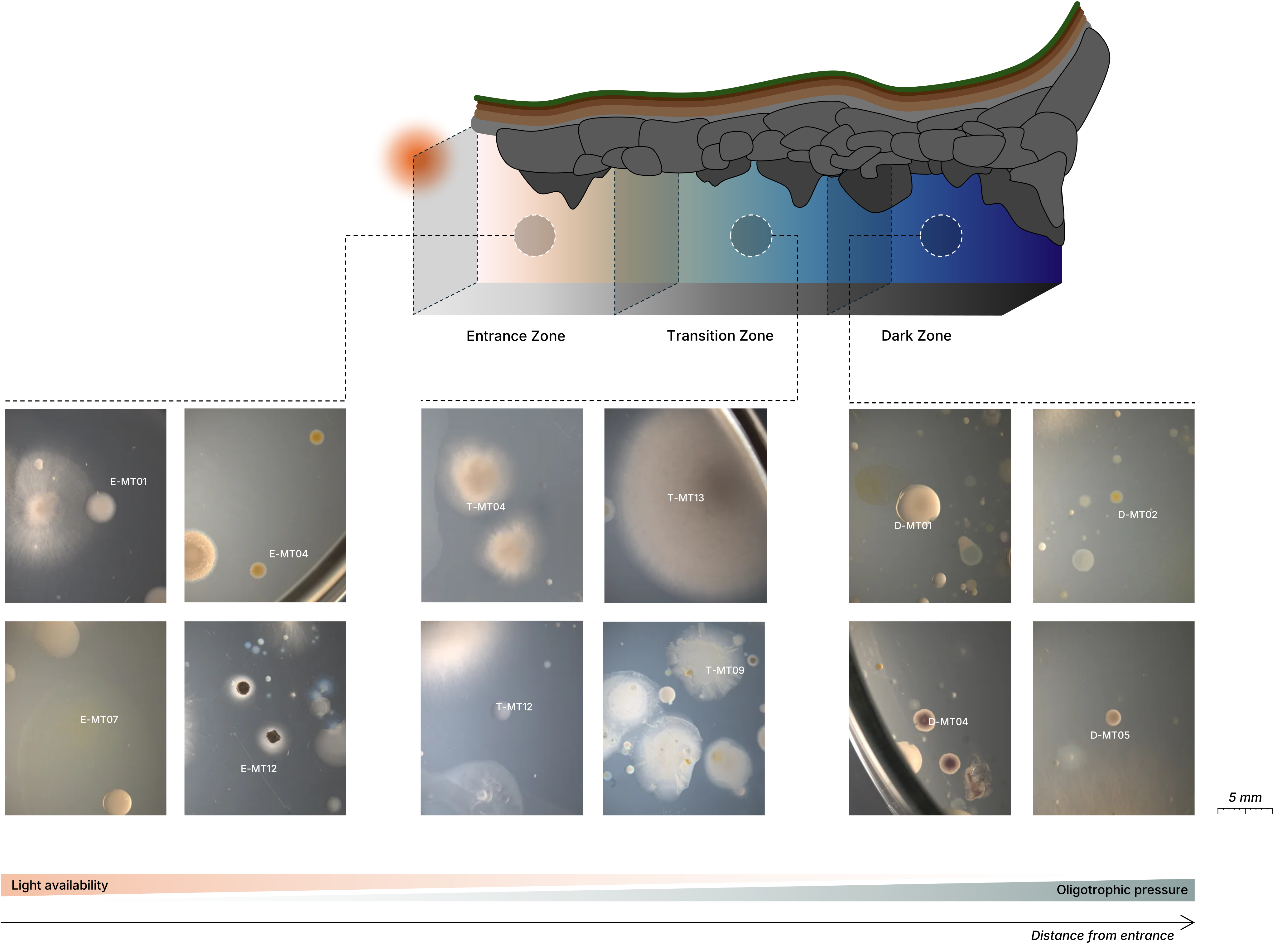
I am a biologist from Jardín, a coffee town on the Western Cordillera of the Colombian Andes. In secondary school I joined OTACA, my school's atmospheric observation group, and reported cloud cover for S'COOL, a NASA program that compared what we saw from the ground with what a satellite recorded overhead. Asking whether two accounts of the same system agree has stayed with me since. At Universidad EAFIT in Medellín, where Dr. Nicolás Pinel advised me throughout my degree, I joined the student research group in microbiology and astrobiology in 2022 and later coordinated it. My thesis followed the cultivable microbial community of the Organal San Antonio, a cave in Támesis, along its gradient of light, often with equipment I had to improvise. A six-month internship in the lab of Dr. Sergio Muñoz-Gómez at Purdue University then took me inside the cell, to how yeasts divide their proteome, and led to a manuscript now in preparation. I am currently applying to graduate programs in ecology and evolution.
As a first-generation student from a rural farming family, I have studied on scholarships at every stage, and Fundación Fraternidad Medellín supported both my degree and my internship at Purdue. I am committed to opening science to students who come from places like mine, where it is not taken for granted.
“It is interesting to contemplate an entangled bank … and to reflect that these elaborately constructed forms, so different from each other, and dependent on each other in so complex a manner, have all been produced by laws acting around us.”
Convergence and contingency recur at several levels of biological organization.
They appear when a community assembles from a pool of species, when an evolving lineage is replayed from the same starting point (Blount et al. 2008), and when cells that once lived apart come to depend on one another (Morris et al. 2012). At each of these levels some outcomes are reproducible and others turn on the order in which things happened. In each case the outcome is probably set neither by rules alone nor by history alone, and what interests me is where the boundary between the two lies and what sets it. More broadly, the questions I would like a career to move through are the evolutionary transitions in biological complexity (Szathmáry 2015; Ratcliff et al. 2012) and the interactions that make them possible, and microbial cells are the system in which I find them both most tractable and most beautiful.
The cave and the yeast cells looked at first like separate problems. One was a community changing along a gradient of light and the other a cell reorganizing under a constraint imposed on it, and I have come to read them as one phenomenon at two resolutions. Working at both resolutions, I would like to bring to fieldwork the same quantitative rigor I learned at the bench. Microbial communities are where the two resolutions meet in a single experiment, because the cells can be characterized before they are combined and the community can be assembled again from the same pool. The two questions below follow from that, the first about when communities converge and the second about whether the cells that build them can predict it.
When is community assembly reproducible, and when does arrival order decide the outcome?
Communities assembled from the same species pool under identical conditions sometimes converge on one reproducible state and sometimes diverge into several, depending on the order in which members arrive (Fukami 2015). Convergence and divergence appear in the same experimental systems. Replicate glucose-limited communities converge at the family level while their species composition diverges (Goldford et al. 2018), and that divergence can arise from multistability in the population dynamics, with chance deciding which state a replicate reaches (Estrela et al. 2022).
In a model, variation in growth traits alone is enough to produce more than one stable state on a single limiting resource (Manhart and Shakhnovich 2018), so the ingredients may be physiological. Ecology has candidate mechanisms for the history-dependent case, such as niche preemption and niche modification, and knows conditions that favor it, such as a large regional pool (Chase 2003). What it does not have is a parameter, measured before assembly begins, that says which regime a given pool will fall into.
That parameter may lie in how each strain allocates its proteome.
Bacterial cells divide a finite proteome between ribosomes, which set growth rate, and the enzymes of metabolism (Scott et al. 2010). Because respiration costs about twice as much protein per unit of energy as fermentation, fast growth can come at the price of yield (Basan et al. 2015). Species traits already predict the strength of priority effects better than phylogenetic relatedness does, once they are separated into what a species requires and how it alters its environment, though so far only for pairs of species (Vannette and Fukami 2014).
The hypothesis is that the spread of allocation strategies across a pool predicts how far replicate communities diverge. Because one partition may set both growth rate and yield, that spread describes where strains sit along the tradeoff, not only how fast they grow. A wide spread may strengthen priority effects, if early arrivals preempt resources that later ones cannot recover, or weaken them, if complementary strategies let late arrivals establish anyway (Debray et al. 2022). Assembling pools of narrow and wide spread under permuted arrival orders, from strains characterized beforehand, distinguishes the two, and if spread does not predict divergence in either direction, the hypothesis is wrong.